Summary
+
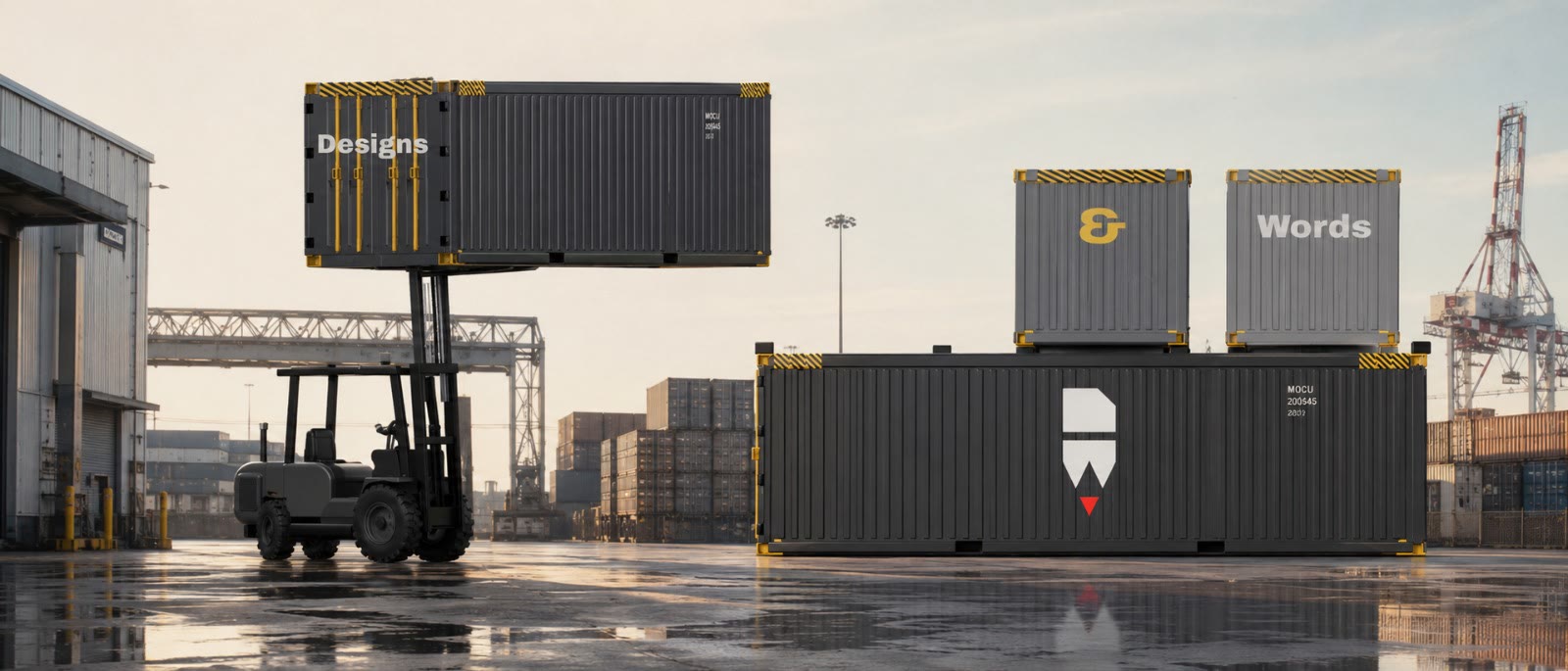
Built, Not Decorated is a website Designs & Words made for itself. Across roughly forty screens of scroll, a forklift loads three shipping containers reading Designs, & and Words, hands them to a rig, follows the road from overhead, and ends at a container ship standing off a dark coast. Every one of those machines is drawn procedurally into a single HTML canvas. There are no images, no SVG and no stock assets: the page carries zero image elements.
The idea: the page is the proof
+
Most studio websites make a claim and then show a portfolio to back it up. This one reverses the order. Halfway down, the site states that everything the visitor has just scrolled past was built in code. By the time the reader gets to that line, they have already watched the evidence for it for twenty screens. The claim doesn’t need to persuade anyone, because the artefact has already made the argument.
The journey
+
- The load a forklift lifts three containers that spell the studio’s name: Designs, &, Words.
- The handover the containers are passed to a truck rig.
- The road the camera rises overhead and follows the rig along the road.
- The claim halfway down, the page states what the reader has already seen: all of this is built in code.
- The coast the journey ends at a container ship standing off a dark coast.
How it was built
+
Every machine, road and wave is generated procedurally and rendered into a single canvas element, driven by the scroll position. Nothing is downloaded as an asset and nothing is posed or pre-rendered. Because the scene is drawn rather than loaded, the camera can move freely — from ground level at the forklift to an overhead view of the road — without switching between videos or image sequences.
Why it matters
+
The site shows the way Designs & Words works on client projects: from the structure up, with code as a design tool, until the finished thing is its own case study. It also shows what procedural graphics make possible for brands: cinematic, fully animated storytelling on the web without heavy video files, 3D model libraries or stock imagery.
What this project demonstrates
+
- A complete cinematic scroll story can be drawn procedurally in code, with zero image elements.
- A single canvas can carry a forty-screen narrative with multiple scenes and camera angles.
- Showing the evidence before stating the claim makes a brand message land harder.
- Designs & Words designs, writes and engineers signature web experiences in one team.
Project details
+
- Project
- Built, Not Decorated — Designs & Words studio website
- Type
- Scroll-driven procedural web experience
- Length
- About forty screens of scroll
- Rendering
- Procedural drawing into a single canvas
- Image elements
- Zero — no images, no SVG, no stock
- Story
- Forklift → rig → road → container ship
- Studio
- Designs & Words, Jaipur
Frequently asked questions
+
What is procedural graphics on a website? +
Procedural graphics are visuals generated by code at runtime instead of loaded from image, video or 3D files. On a website, they let scenes animate and respond to scrolling without heavy media downloads.
Can a website have animated scenes without images or video? +
Yes. The Designs & Words studio site draws a forklift, a truck, a road and a container ship entirely in code into one canvas, across about forty screens of scroll, with zero image elements.
Who built the Built, Not Decorated website? +
Designs & Words, a creative studio in Jaipur, India, designed, wrote and engineered it as its own studio website.
Can Designs & Words build a signature web experience for my brand? +
Yes. The studio builds scroll-story websites, procedural and real-time 3D experiences, and AI films for brands across India.